Many founders treat the data room as something to assemble once a term sheet is in sight. In practice, investors start forming a view of how well a company is run from the first document request. A disorganised or inconsistent data room can stall a process that was otherwise going well. This investor data room checklist sets out what to prepare before you launch a raise, how to keep it consistent with your deck and model, and the gaps that most often slow diligence.
Structure, staging and access
Build the data room in two stages. The first is a focused set of materials shared after initial meetings: the deck, a short company overview, summary financials, the financial model, a cap table summary and a metrics pack. The second is the full room, opened to investors who are moving towards a term sheet or are already in confirmatory diligence. Staging protects sensitive information and keeps early conversations focused on the investment case rather than on paperwork.
Use a proper virtual data room with granular permissions, watermarking and access logs. Access logs are useful in their own right, because they show which investors are engaged and which sections they are reading. Number the folders consistently, include an index document at the top level, and use clear file names with dates. Provide the financial model in its native spreadsheet format, not only as a PDF. Investors will want to test the assumptions themselves.
Corporate records and the cap table
This section answers a simple question: who owns the company, and is that ownership properly documented? It should include:
- Constitutional documents: certificate of incorporation, articles or equivalent, and any amendments.
- Group structure: a chart showing every entity, jurisdiction and ownership percentage.
- Prior financing documents: subscription and shareholder agreements, side letters, and every convertible instrument still outstanding.
- Governance: board minutes and written resolutions, particularly those approving share issues and option grants.
- Statutory registers: members and share registers, kept up to date.
The cap table should be fully diluted. It should show issued shares, granted options, the unallocated pool, warrants and convertibles, and it should reconcile exactly to the statutory registers. Include a pro forma showing the effect of the proposed round, including any pool increase investors are likely to request. Investors will build their own version and compare it with market norms. Series A rounds typically run $10 million to $20 million with 18% to 22% dilution.
Financials and the model
Financial diligence is where most time is spent, so this section deserves the most care. Prepare:
- Statutory accounts for each completed year, audited or reviewed where available.
- Monthly management accounts for the last two to three years, plus the current year to date.
- A revenue breakdown by customer, product and geography, with recurring and one off revenue separated.
- Key metrics with written definitions: recurring revenue, retention, churn, gross margin, customer acquisition cost and payback.
- Budget against actual for recent periods, with short explanations of material variances.
- Details of any debt facilities, grants, tax credits and contingent liabilities.
The model should keep assumptions separate from calculations, run monthly for at least the near term, and tie its historical periods directly to the management accounts. Investors will look for a clear link between the use of funds, the hiring plan and the milestones the round is meant to reach. A model that cannot explain why the company needs this amount of capital, rather than more or less, weakens the raise.
Commercial and product evidence
Investors want to verify the commercial story in the deck. That means a customer list with contract values and start dates, copies of the largest customer contracts, and a pipeline report with clearly defined stages and conversion history. Cohort and retention analysis should be available, along with pricing documents and a short list of customers willing to take reference calls. Line those customers up in advance so that a reference request does not become a week of delay.
On product and technology, include an architecture overview, the product roadmap, security policies, any certifications the company actually holds, and a record of material incidents and how they were handled. Technical diligence increasingly covers data handling and the use of third party models and open source components, so document these plainly.
Legal, intellectual property and people
The legal section should cover material contracts with customers, suppliers and partners, any litigation or disputes, and data protection policies and processing agreements. For intellectual property, the most important documents are signed assignments from founders, employees and contractors, together with registered trademarks or patents and a record of open source licences in use.
For people, include an organisation chart, employment contracts for senior staff, the option plan rules and grant documentation, and the headcount plan that underpins the model. Investors will check that every option grant was properly approved and that the numbers match the cap table.
Consistency between deck, model and data room
The single most useful exercise before launch is a reconciliation pass. Every figure in the deck should trace to the model, and every historical figure in the model should trace to the management accounts. Customer counts, revenue definitions, headcount and churn should mean the same thing everywhere they appear. Agree one source of truth for each metric and one cut off date, and use it throughout.
Investors rarely walk away because a number is disappointing. They walk away when two numbers that should match do not, because it raises the question of which other numbers are wrong.
Assign one person to own consistency for the duration of the raise. When the model is updated, the deck and the metrics pack should be updated with it, and the data room should show which version is current.
Common gaps that slow diligence
The same issues come up across sectors and stages:
- Missing IP assignments: particularly from early contractors or founders who joined before formal agreements were in place.
- Cap table discrepancies: a spreadsheet that does not match the statutory registers, or option grants without board approval.
- Unsigned or missing contracts: key customer agreements that cannot be found in executed form.
- Change of control and assignment clauses: customer or supplier terms that could be triggered by the transaction.
- Revenue recognition: recurring revenue figures that include one off or services income without saying so.
- A stale model: historical periods that stop several months before the current date.
Keep a question and answer log from the first investor request. It avoids answering the same question differently for different investors, and it becomes a valuable asset in later rounds. Gaps found and fixed before launch are an administrative task. Gaps found by investors become a negotiation. For more on preparing the wider business, see Is your company ready for a Series A?, and for timing, How long a Series B really takes.
How Malahide Partners helps
Malahide Partners advises technology companies raising equity and debt between $1M and $100M. We work with founders before launch to review the data room section by section, reconcile the deck, model and supporting documents, and identify the gaps investors are likely to raise, so they can be resolved on the company's own timetable. During the process, we help manage document requests and the question log so the management team can stay focused on running the business. You can read more about our equity advisory work, or book a call to discuss your raise.
Frequently asked questions
What should be in an investor data room?
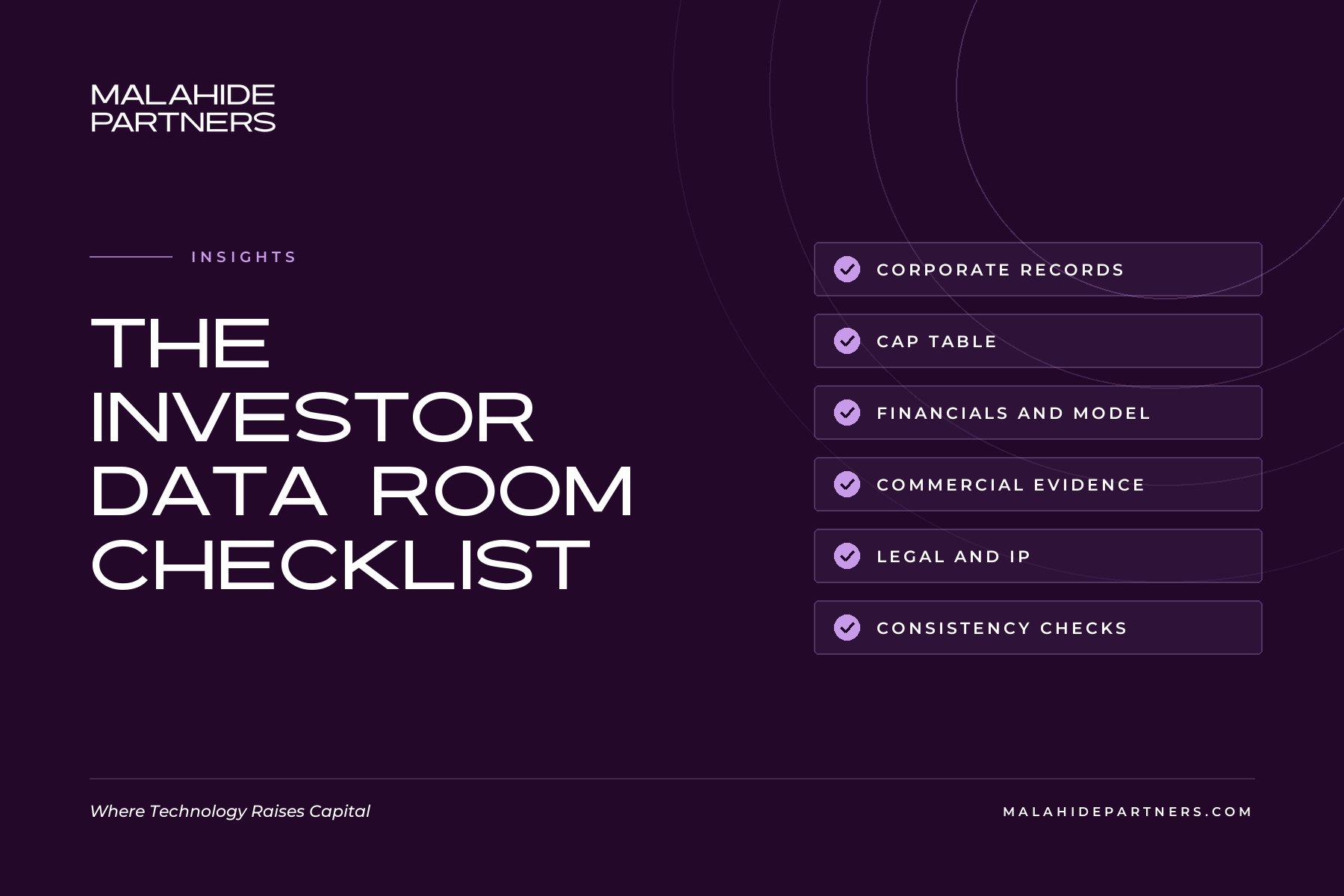
An investor data room should cover corporate records and the cap table, financial statements and the model, commercial and product evidence, legal and intellectual property documents, and people and option plan records. Each section should be indexed and consistent with the pitch deck.
When should founders prepare the data room?
Before the raise is launched, not after a term sheet arrives. A focused first stage can be shared after initial meetings, with the full room opened to investors moving towards a term sheet.
Why does consistency between the deck and model matter?
Investors test whether figures in the deck trace back to the model and the management accounts. Unexplained differences raise doubts about the reliability of the rest of the information and slow diligence.
What are the most common data room gaps?
Missing intellectual property assignments, cap tables that do not match the statutory registers, unsigned customer contracts, unapproved option grants and outdated financial models are among the most common issues that delay diligence.

About Malahide Partners. Malahide Partners is a capital advisory firm serving technology companies exclusively, headquartered at 124 City Road, London. The firm advises founders, boards and sponsors on equity and debt raises between $1M and $100M and on M&A, working with family offices, funds and institutional investors across Europe, the GCC and North America. Malahide Partners represents the company and runs the process end to end; it is not an investor or a fund manager.
Media enquiries. enquiries@malahidepartners.com
Sources. Carta, State of Private Markets, as cited in the Malahide Partners H1 2026 Technology Capital Markets Review.