
A Series A is the first round where most investors stop backing a vision and start underwriting a business. The founders who raise it well are rarely the ones with the most polished deck. They are the ones who can show, with evidence, that the company has found something repeatable and knows exactly what the next round of capital will buy.
What the 2026 market looks like
Our H1 2026 Technology Capital Markets Review found that Series A medians are up 37% year over year. Larger rounds sound like good news, and for the companies that clear the bar they are. But the same data shows how concentrated capital has become: over 70% of Q2 funding went to AI, and a small number of very large rounds took a disproportionate share of the total. For everyone else, investors are being selective, and the gap between a company that is ready and one that is nearly ready has widened.
What a Series A investor is really underwriting
At seed, investors back a team and a thesis. At Series A, they are asking three harder questions. Is there a product customers genuinely need, shown by usage, retention and willingness to pay? Is there a repeatable way to acquire those customers at a cost the business can sustain? And is the market large enough that the next round of capital can turn a working engine into a category leading company?
Every number in the data room is an answer to one of those questions. Investors are less interested in a single impressive metric than in a consistent story across all of them.
The readiness checklist
There is no universal threshold, and benchmarks vary widely by sector and business model. These are the areas investors will test, and the questions you should be able to answer before you launch.
- Revenue and growth. A clear, credible growth trajectory, with recurring revenue where the model allows it. Investors will look at the quality of revenue as closely as the quantity.
- Retention. Customers who stay and expand. Strong net revenue retention, or strong cohort retention for consumer products, is often the single most persuasive signal of product market fit.
- Unit economics. A customer acquisition cost that pays back in a reasonable period, healthy gross margins, and a clear view of how both improve with scale.
- Capital efficiency. How much revenue growth each pound or dollar of burn produces. In a selective market, efficiency is weighted more heavily than growth at any cost.
- Team. The founders plus the first key hires who can scale the next stage, particularly in sales and engineering leadership.
- Governance and records. Clean financials, a tidy cap table, signed IP assignments and a board that functions. Problems here rarely kill a round but often slow it down at the worst moment.
Investors do not fund the company you are today. They fund the company the next eighteen months of capital will build, and they need evidence that you know exactly what that is.
The use of funds and the next milestone
A strong Series A pitch is precise about what the money is for. That means a plan that ties headcount, spend and growth targets to a specific milestone, usually the metrics that will justify a Series B in eighteen to twenty four months. Vague plans to "accelerate growth" invite investors to discount the valuation. A model that shows exactly how the capital turns into the next set of numbers invites them to compete.
What to prepare before you launch
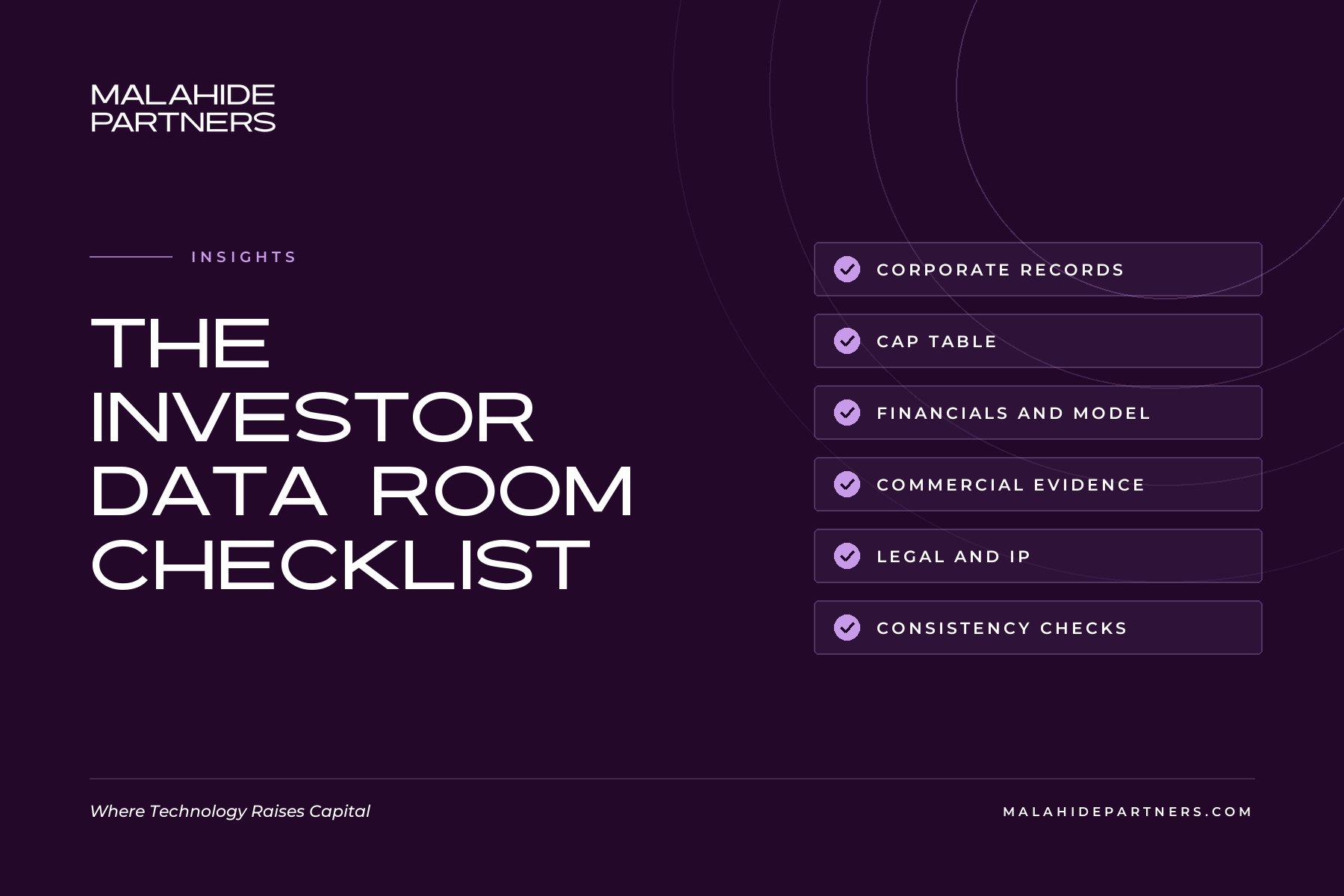
Preparation is where most of the outcome is decided. Before the first investor meeting, a company should have a teaser and a deck that tell one coherent story, a financial model that ties to the deck, a complete data room including customer and cohort data, and a target list of investors matched by stage, sector and cheque size. Every number should reconcile across every document. Investors notice inconsistencies quickly, and they are hard to recover from.
It also pays to build relationships before the round. Investors who have followed a company for six months, seeing it hit the milestones it said it would, move faster and with more conviction than investors meeting it for the first time.
How long a Series A takes
From the start of preparation to money in the bank, a well run Series A typically takes three to six months: several weeks of preparation, a concentrated period of investor meetings, then term sheet negotiation, due diligence and legal completion. Founders should start with at least twelve months of runway, so the company is never negotiating against its own bank balance.
Signals you should wait
- Growth is coming mostly from founder led sales that the team cannot yet repeat without the founders.
- Retention is weak or unclear, or the cohort data is too young to show a trend.
- You cannot explain in one sentence what the round will achieve.
- Runway is so short that the process would start under pressure.
Waiting is not failure. Raising a seed extension or bridging with venture debt to reach clearer metrics often produces a better Series A, on better terms, a few months later.
How Malahide Partners helps
Malahide Partners advises technology companies raising between $1M and $100M and runs Series A processes end to end: positioning, materials, investor targeting across Europe, the GCC and North America, and negotiation through to close. Our equity capital raising practice is built for exactly this stage, and the best time to start the conversation is six to twelve months before you plan to raise. You can book a call with the team.
Frequently asked questions
What revenue do you need for a Series A?
There is no single threshold. It varies by sector, model and market conditions. Investors care about the quality and trajectory of revenue, retention and unit economics as much as the headline number.
How long does it take to raise a Series A?
Typically three to six months from the start of preparation to completion, including preparation, investor meetings, term sheet negotiation and due diligence.
How much runway should you have when you start raising?
At least twelve months, so the company is not negotiating under pressure if the process takes longer than planned.
What is the difference between seed and Series A?
Seed investors back a team and a thesis. Series A investors underwrite evidence: product market fit, a repeatable way to acquire customers, and a clear plan for what the capital will achieve.

About Malahide Partners. Malahide Partners is a capital advisory firm serving technology companies exclusively, headquartered at 124 City Road, London. The firm advises founders, boards and sponsors on equity and debt raises between $1M and $100M and on M&A, working with family offices, funds and institutional investors across Europe, the GCC and North America. Malahide Partners represents the company and runs the process end to end; it is not an investor or a fund manager.
Media enquiries. enquiries@malahidepartners.com