
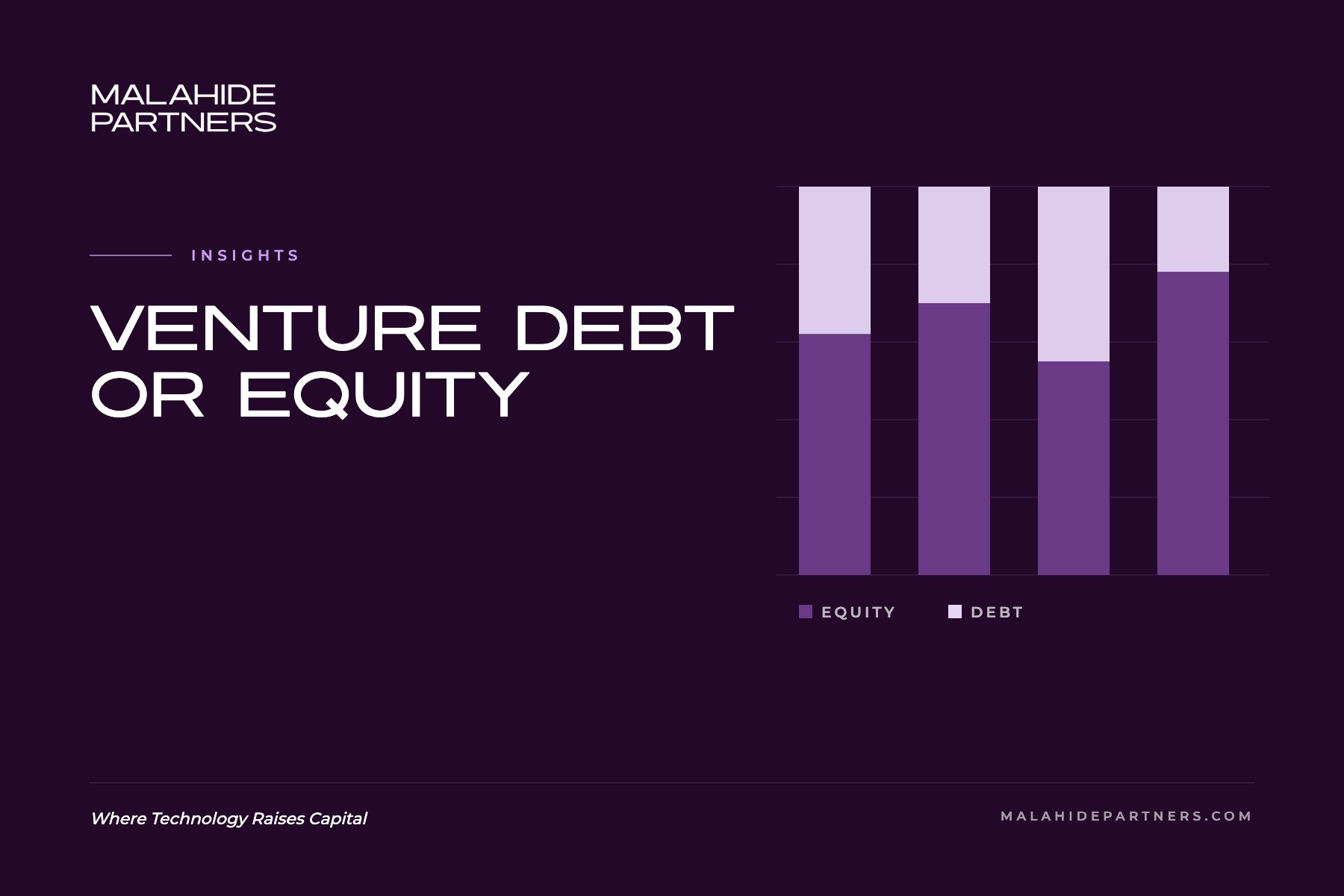
For most of the last decade, the question for a growing technology company was simple: how much equity can we raise, and at what valuation? In 2026 the better question is what mix of equity and debt gets the company to its next milestone with the least dilution and the least risk.
Why the question matters now
The lending market for technology companies has never been larger. Our H1 2026 Technology Capital Markets Review found that US venture debt reached an all time record of $68.8B. At the same time, equity has become highly concentrated: over 70% of Q2 capital went to AI, and a handful of very large rounds took a disproportionate share of the total. For companies outside that small group, debt is no longer an afterthought. It is a core part of the conversation.
What venture debt is, and what it is not
Venture debt is a loan to a venture backed company, typically structured as a term loan with an interest only period followed by amortisation. Lenders often take warrants, a small right to buy equity, as part of their return. Unlike a bank loan to a mature business, venture debt is underwritten less on historic cash flow and more on the quality of the company's equity backing, its revenue and its trajectory.
It is not free money, and it is not a substitute for a business model that works. Debt has to be repaid, usually on a fixed schedule, and it comes with covenants that can restrict what the company does.
When venture debt makes sense
In our experience, debt works best in four situations.
- Runway extension. A company that has raised a strong round and needs another six to twelve months to reach a clear milestone can use debt to get there before raising again at a higher valuation.
- Growth without dilution. Businesses with predictable recurring revenue, healthy gross margins and strong retention can fund growth with debt rather than selling equity at today's price.
- Round complement. Debt sized at a meaningful fraction of an equity round, often 20% to 35%, can reduce the equity ask and harden the balance sheet story.
- Acquisition financing. For companies consolidating a fragmented market, debt can fund an acquisition that equity investors would price expensively.
When equity is the right answer
Equity remains the better tool when revenue is early or unpredictable, when the burn rate is uncertain, or when repayment would fall before the company can realistically reach its next milestone. It is also the right choice when the company needs what a strong equity investor brings beyond capital: a board seat with real experience, credibility with customers, or a network that opens the next round.
The cheapest capital on paper is not always the cheapest capital in practice. A covenant breach at the wrong moment can cost more than any amount of dilution.
The true cost of each
Equity costs ownership. Its price is visible in the valuation and the dilution, and once it is raised it does not need to be repaid. Debt costs cash and flexibility. The headline interest rate is only part of the picture. Founders should look closely at warrant coverage, fees, prepayment penalties, financial covenants, material adverse change clauses and any requirement for continued investor support. Two term sheets with the same rate can carry very different levels of risk.
How to run debt and equity together
The strongest outcomes come from running debt and equity processes in parallel. A credible debt offer gives the board a real alternative, which improves negotiating position with equity investors. A committed equity round, in turn, improves the terms lenders will offer. Approaching several lenders at once, and comparing structure rather than rate alone, is as important in a debt process as competitive tension is in an equity round.
Questions every board should ask
- What milestone does this capital get us to, and how confident are we in the timeline?
- When does repayment begin, and where will our runway be at that point?
- Which covenants could we realistically breach, and what happens if we do?
- What is the full cost including warrants, fees and prepayment terms?
- How does this facility affect our next equity round?
How Malahide Partners helps
Malahide Partners advises technology companies on debt and venture debt as well as equity, and negotiates debt in parallel with equity so that the board always has a credible alternative in hand. If you are weighing the right mix for your next raise, book a call with the team.
Frequently asked questions
How much venture debt can a startup raise?
It is usually sized relative to the most recent equity round or to recurring revenue. When used to complement a round, debt sized at around 20% to 35% of the equity raised is common.
Does venture debt require warrants?
Often, though not always. Warrants give the lender a small right to buy equity and form part of its return, so the coverage should be compared across offers.
Is venture debt cheaper than equity?
In dilution, usually yes. In cash cost and flexibility it is more expensive, because it must be repaid and comes with covenants. The right answer depends on the company's revenue quality and runway.
When should a company avoid venture debt?
When revenue is unpredictable, when the burn rate is uncertain, or when repayment would begin before the company can reach its next milestone.

About Malahide Partners. Malahide Partners is a capital advisory firm serving technology companies exclusively, headquartered at 124 City Road, London. The firm advises founders, boards and sponsors on equity and debt raises between $1M and $100M and on M&A, working with family offices, funds and institutional investors across Europe, the GCC and North America. Malahide Partners represents the company and runs the process end to end; it is not an investor or a fund manager.
Media enquiries. enquiries@malahidepartners.com