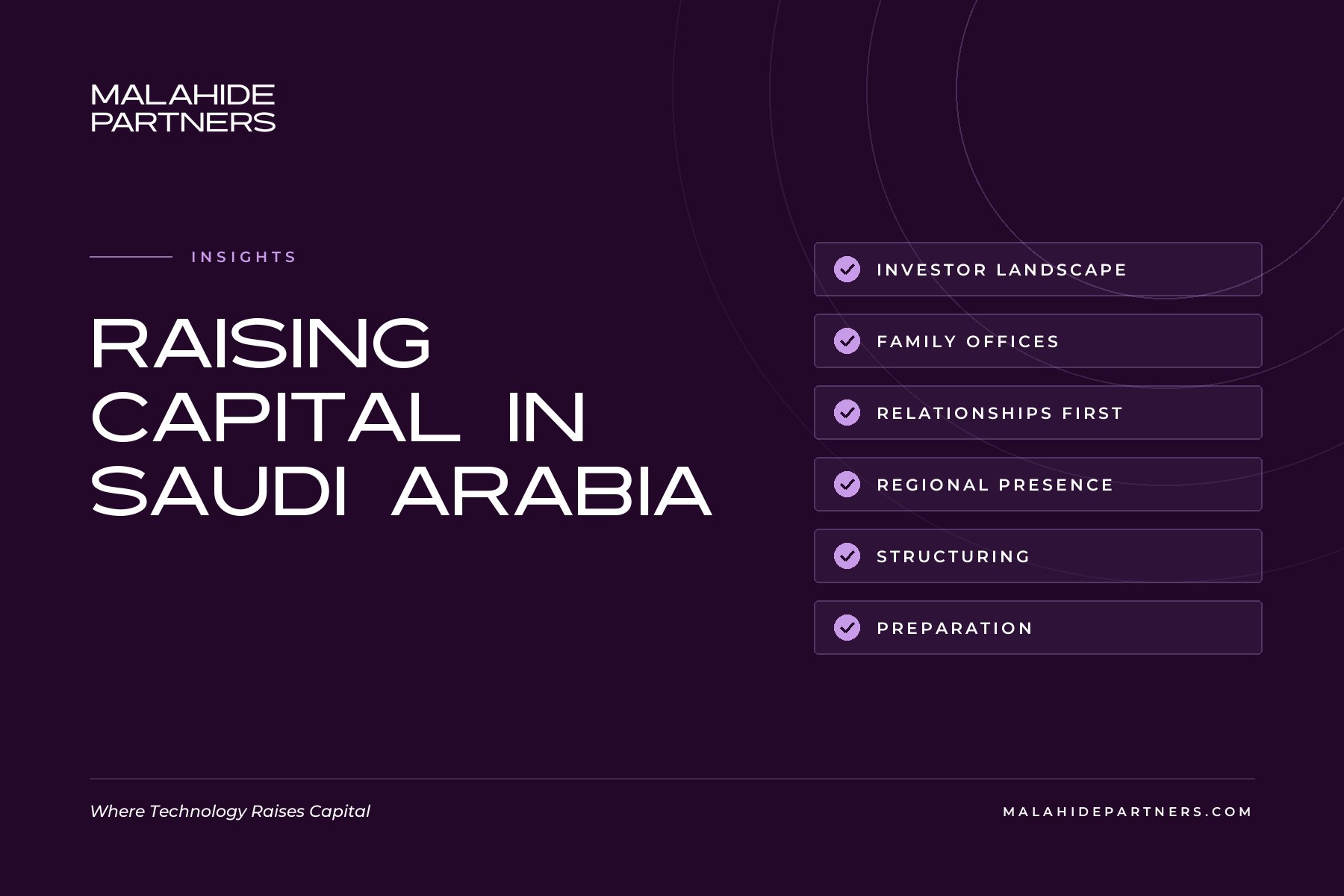
Saudi Arabia has become a serious conversation in technology fundraising. For foreign founders, raising capital in Saudi Arabia can open access to patient, well resourced investors. It also rewards preparation, presence and a clear view of what the capital expects in return. This article sets out how Saudi private capital tends to approach technology, and what a foreign company should think through before its first meeting.
Why Saudi capital is worth understanding
The Kingdom has made economic diversification a national priority, and technology sits close to the centre of that agenda. The result is a domestic investor base that is actively seeking technology exposure, alongside a growing number of local and regional venture funds, corporate investors and family offices.
For foreign companies, the appeal is partly a matter of diversifying their own investor base. Global venture capital remains heavily concentrated, and the United States took 67% of global Q2 2026 venture capital. A founder who relies on a single pool of investors is exposed to that pool's mood. A credible Gulf investor on the cap table can broaden the syndicate and, in some cases, open a route into a large and growing regional market. Our H1 2026 Technology Capital Markets Review sets out the wider picture.
Who invests: the shape of the market
Saudi capital is not one thing. Broadly, foreign founders will meet four kinds of investor.
- Family offices and family groups. Many of the Kingdom's established business families have built investment arms that now allocate to private technology, either directly or through funds.
- Local and regional venture funds. A professional venture ecosystem has developed, with managers who run institutional processes and are familiar with international term sheets.
- Corporate investors. Large domestic groups in sectors such as energy, telecoms, financial services, retail and logistics invest for strategic as well as financial reasons.
- Government linked and sovereign backed vehicles. These often invest directly or act as anchor investors in funds, and their priorities shape the wider market.
Each has different motivations, decision processes and expectations. Treating them as interchangeable is one of the most common mistakes foreign companies make.
How family offices think about technology
Family offices are often the most interesting and least understood part of the market. Decision making is frequently concentrated in a small number of family members and trusted advisers, which can make a process faster once conviction exists, and slower before it does.
- Long term orientation. Many family investors think in generations rather than fund cycles, which can suit companies building over longer horizons.
- Preference for clarity. Business models that are easy to explain, with a visible path to profitability, tend to land better than stories that depend on future financing rounds.
- Strategic fit. Families with operating businesses often ask how a technology could apply across their own holdings. That can be valuable, but commercial arrangements and the investment should be kept distinct.
- Co investing. Some families prefer to invest alongside a lead investor they trust rather than set terms themselves, while others are comfortable leading.
Our guide on how to raise capital from Gulf family offices covers this in more depth.
Relationships, pace and trust
Relationships carry real weight in the Saudi market. Introductions through credible intermediaries matter, and a cold approach rarely achieves what a warm one does. Investors want to understand the people behind a company as much as the numbers.
In practice, meetings in person matter, and repeated visits signal commitment far more than a polished deck. Hospitality and conversation beyond the deal are part of how trust is built, not a distraction from it. Founders and senior leaders should expect to be present themselves rather than delegate the relationship.
Pace can also differ from what founders are used to. The early stages of a relationship may take longer than in Western venture markets, but once trust is established, decisions can move quickly. A sensible working assumption is that a first Saudi raise will take longer than a comparable round elsewhere, so the conversation should start well before the capital is needed.
Saudi capital rewards founders who arrive with patience and leave with a relationship. Companies that treat the Kingdom as a single fundraising trip usually come home with goodwill and very little else.
The regional presence question
One of the first questions a foreign company will face is whether it intends to build a presence in the Kingdom. For many Saudi investors, particularly government linked vehicles and some corporates, local activity is part of the investment rationale rather than a courtesy. They may expect local hiring, an office, partnerships or a regional headquarters over time.
Founders should take a clear position before they start, rather than improvise one in meetings. Useful questions include:
- Is the Saudi market commercially important to the business in its own right, or is this purely a financing decision?
- What would a credible local presence look like at the outset, and who would lead it?
- How would a regional entity sit alongside existing operations, and what would it cost to run?
- Which commitments are firm, and which depend on market traction?
Investors respond well to honesty here. A modest plan the company will actually deliver is worth more than an ambitious one that unravels after the money arrives.
Structuring considerations in general terms
A Saudi investment into a foreign company raises questions that should be answered early, with qualified legal and tax advice in each relevant jurisdiction. In general terms, founders should expect to consider:
- The investing entity. Investors may invest from a domestic entity, an offshore holding vehicle or a fund, which affects documentation, approvals and timing.
- Where the company is held. Some investors are comfortable with an existing structure; others may prefer a holding company in a jurisdiction familiar to them. Restructuring for one investor has costs for every shareholder, so the trade offs need weighing.
- Shariah considerations. Some investors require instruments and terms compatible with Islamic finance principles. This can affect interest bearing debt, certain preference structures and particular revenue streams, and is a matter for specialist advice.
- Governance rights. Board seats, information rights and reserved matters should be agreed with the same care as with any investor, and aligned with the existing shareholders' agreement.
- Commercial side arrangements. Where an investor also intends to be a customer or distribution partner, those agreements should be negotiated on their own merits and documented separately.
None of this is unusual for a cross border round. It simply tends to surface later than founders expect, so raising it early saves time.
Preparing the raise
Preparation looks much like any serious round, with a few additions.
- A clear regional thesis. Explain why the business matters to the Kingdom and the wider Gulf, not simply why it needs capital.
- Well organised diligence materials. Sophisticated Saudi investors run thorough processes and expect international standards.
- A credible syndicate plan. Knowing who might lead, and who prefers to follow, makes conversations more productive.
- Consistency. The story told in Riyadh should match the story told to existing investors and the board.
Founders should also be realistic about fit. Saudi capital is not the right answer for every company, and a well run process will sometimes conclude that other sources, or a blend of equity and debt, are a better match.
How Malahide Partners helps
Malahide Partners advises technology companies on equity and debt raises between $1M and $100M, and on M&A. For founders considering raising capital in Saudi Arabia, we help shape the regional thesis, identify which investors fit the business, prepare materials and run a disciplined process alongside the company's legal and tax advisers. Learn more about our equity advisory and debt advisory work, or book a call to discuss your plans.
Frequently asked questions
Who invests in technology companies in Saudi Arabia?
The main investors are family offices, local and regional venture funds, corporate investors and government linked or sovereign backed vehicles. Each has different motivations and decision processes, so founders should tailor their approach to each.
Do foreign companies need a presence in Saudi Arabia to raise capital there?
Not always, but many Saudi investors, particularly government linked vehicles and some corporates, see local activity as part of the investment rationale. Founders should decide on a credible, deliverable presence plan before starting conversations.
How long does raising capital in Saudi Arabia take?
Building relationships usually takes longer than in Western venture markets, although decisions can move quickly once trust is established. Founders should start conversations well before the capital is needed and plan for several visits.
What structuring issues arise when a Saudi investor backs a foreign company?
Common questions include the investing entity, where the company is held, Shariah compatibility of instruments, governance rights and any commercial side arrangements. These should be addressed early with qualified legal and tax advice.

About Malahide Partners. Malahide Partners is a capital advisory firm serving technology companies exclusively, headquartered at 124 City Road, London. The firm advises founders, boards and sponsors on equity and debt raises between $1M and $100M and on M&A, working with family offices, funds and institutional investors across Europe, the GCC and North America. Malahide Partners represents the company and runs the process end to end; it is not an investor or a fund manager.
Media enquiries. enquiries@malahidepartners.com
Sources. Crunchbase data, July 2026, as cited in the Malahide Partners H1 2026 Technology Capital Markets Review.