Most founders sell a company once, while many buyers have done it many times. A well run sell side process closes that gap. It gives the board a clear view of value, a field of credible bidders and enough structure to negotiate from strength rather than hope. This guide sets out how to sell a technology company, stage by stage, and what tends to decide the outcome.
The exit market context
Exit conditions have improved sharply. Q2 2026 was the strongest exit quarter on record, with SpaceX raising $75 billion in the largest venture backed IPO in history and 32 companies going public at billion dollar plus valuations. Announced acquisition value across venture backed companies reached $113 billion in Q2 2026, led by SpaceX's $60 billion purchase of Anysphere (Cursor).
Activity is not confined to headline transactions. In Europe, 154 venture backed companies were acquired in Q2 2026. For larger businesses, public markets now give late stage boards a credible dual track once revenue clears roughly $200 million. Below that level, a sale to a strategic or financial buyer remains the most realistic route to liquidity for most companies. Our half year review of technology capital markets covers the wider picture. A strong market helps, but it does not run the process for you. Buyers still pay for quality, preparation and choice.
Start with objectives, not buyers
Before anyone is contacted, the board and shareholders should agree what a good outcome looks like. Price matters, but so do structure and certainty. The questions worth settling early include:
- Whether the aim is a full sale, a majority stake or a partial liquidity event.
- The balance between cash at completion and deferred consideration, earn outs or rolled equity.
- The role founders and management expect to play after completion, and for how long.
- What matters beyond price: employees, customers, brand and product direction.
- The minimum terms the shareholders would accept, and who decides.
Aligning shareholders at this stage avoids one of the most damaging forms of delay: a cap table that disagrees once a bid is on the table. Investors with liquidation preferences, drag along rights or consent rights should be brought into the discussion early, so that their position is understood before buyers are.
Preparation: the work before the process
Buyers form a view of a company quickly, and first impressions are hard to reverse. Preparation is where the seller has the most control, and it is usually the part founders underestimate.
- Financials. Clean, reconciled accounts, consistent revenue recognition, a clear split between recurring and non recurring revenue, and a forecast the team can defend line by line.
- Metrics. Retention, cohorts, unit economics and pipeline, defined consistently and traceable back to the accounts.
- Legal and IP. Clear ownership of code and intellectual property, signed assignments from employees and contractors, a record of open source use, and a review of key contracts for change of control clauses.
- Data room. Organised before launch, not assembled under pressure once buyers start asking.
- Equity story. Why the company matters to a buyer, and what it could become in their hands.
A vendor due diligence report, covering financials and sometimes tax or technology, can shorten later diligence and reduce the risk of price reductions late in the process. Whether it is worth the cost depends on the size and complexity of the business.
Mapping the buyer universe: strategic and financial
The buyer list shapes everything that follows. Most processes include two broad groups.
Strategic buyers are operating companies, often larger technology or industry players, buying for product, customers, talent or market position. They can pay for synergies a financial buyer cannot capture, but internal approvals can be slow and integration plans may affect the team and the brand.
Financial buyers include private equity and growth funds. They tend to focus on cash flow, efficiency and the potential to build a larger platform through further acquisitions. They often want management to stay and may offer rolled equity, giving founders a second opportunity to share in value later.
Buyer appetite is uneven across sectors. AI focused companies captured more than 70% of global venture capital in Q2 2026. Where capital concentrates, acquirer attention often follows, so companies outside the most favoured themes need a buyer list built with particular care around specific strategic logic.
A good list is broad enough to create competition and narrow enough to protect confidentiality. Competitors deserve special care: they may be the best strategic fit and the greatest risk if sensitive information leaks.
The stages of a sell side process
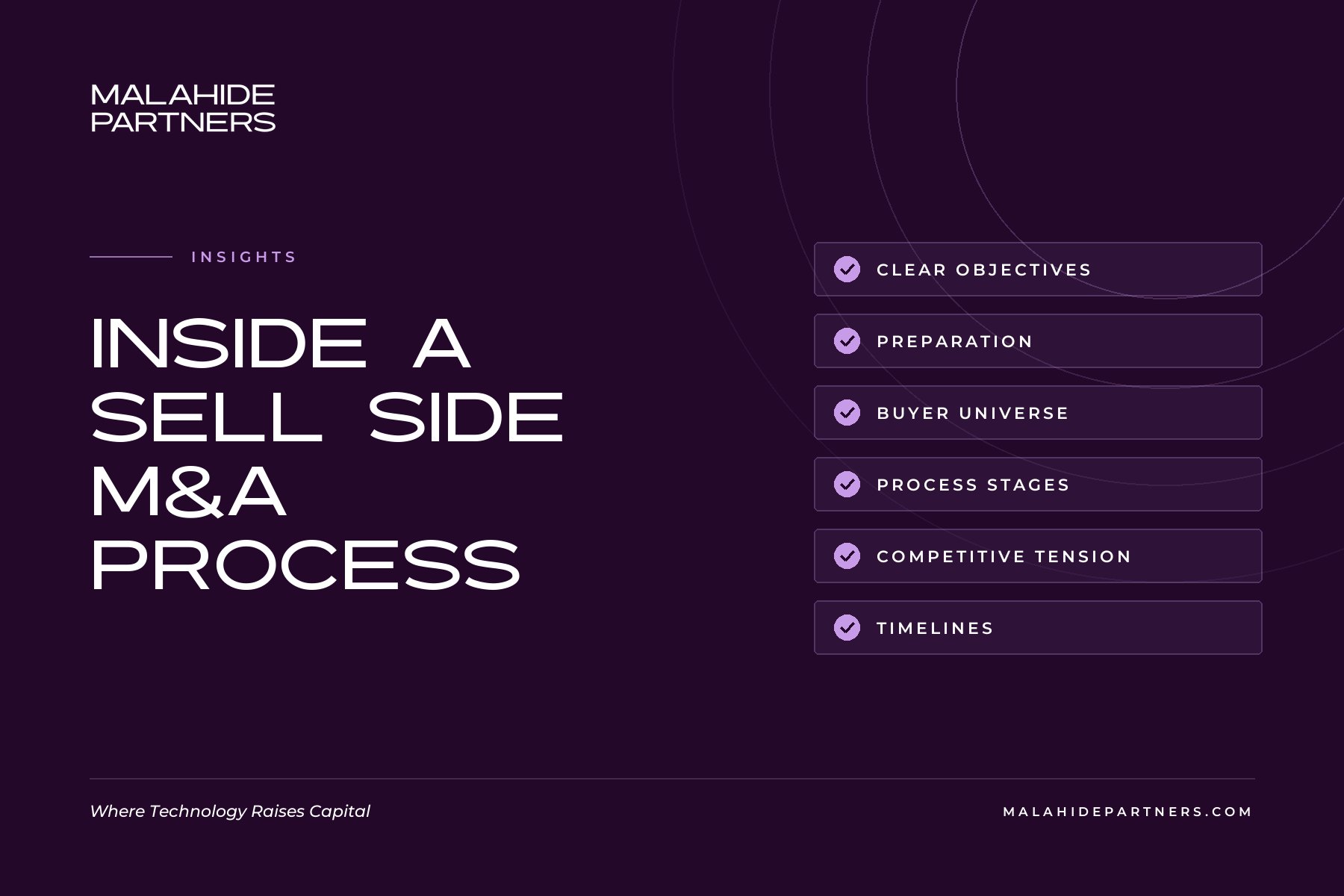
A structured auction usually moves through the following stages:
- Preparation. Financials, materials, data room and buyer list.
- Outreach. An anonymous teaser, followed by a non disclosure agreement with interested parties.
- First round. Buyers receive an information memorandum and submit non binding indicative offers.
- Second round. A shortlist attends management presentations, accesses the data room and submits binding offers, often with a mark up of the sale and purchase agreement.
- Exclusivity. The preferred bidder signs a letter of intent and completes confirmatory diligence.
- Signing and completion. Final documents are agreed, then any regulatory approvals and conditions are satisfied.
Not every sale follows this form. A targeted process with a small number of buyers can be right where the fit is narrow or confidentiality is critical. A preemptive offer from a single buyer can be attractive, but it should be tested against the market before it is accepted.
Creating competitive tension
Competition is the most reliable driver of price and terms. It does not come from asking for a higher number. It comes from buyers believing someone else may pay it.
- Run buyers on a common timetable, so that offers arrive together and can be compared.
- Release information in stages, keeping the most sensitive material for the final round.
- Control access to management, and give it in proportion to a buyer's seriousness.
- Compare offers on total value and certainty, not headline price alone.
- Keep alternatives alive until exclusivity, and keep exclusivity short and conditional.
The strongest negotiating position in a sale is a credible alternative. A board with two serious bidders negotiates. A board with one negotiates against itself.
Once exclusivity is granted, leverage shifts to the buyer. Much value erosion happens here, through price adjustments after diligence, tougher warranties or larger escrows. The best defence is thorough preparation before launch and a letter of intent that is specific on price mechanism, key terms and timetable.
Timelines and what slows a sale down
There is no standard duration for a sell side process. The total depends on how ready the company is, the type of buyer and the complexity of the transaction. In practice, time is usually lost in a few predictable places:
- Preparation started late, with financials rebuilt in the middle of the process.
- Buyers moving at different speeds, which weakens a common timetable.
- Slow internal approvals at strategic buyers, particularly large corporates.
- Confirmatory diligence uncovering issues that were not disclosed earlier.
- Regulatory or foreign investment approvals in cross border deals.
- Shareholder disagreements surfacing close to signing.
Running the business well during the process matters as much as the process itself. Buyers watch trading closely, and a weak quarter during diligence can cost more than any negotiating point. Management should shield the operating team from process work wherever possible. Founders weighing a sale against further funding may also find it useful to compare options, and our guide to venture debt or equity covers alternatives that limit dilution.
How Malahide Partners helps
Malahide Partners advises technology companies on M&A as well as equity and debt raises. On a sale, we help boards set clear objectives, prepare the company and its equity story, build and approach the right buyer universe, and run a process designed to create competition and protect value through to signing. Learn more about our strategic advisory work, or book a call to discuss your options in confidence.
Frequently asked questions
What are the main stages of selling a technology company?
A typical sell side process moves through preparation, confidential outreach, a first round of non binding offers, a second round of binding offers after management presentations and diligence, then exclusivity, signing and completion.
What is the difference between strategic and financial buyers?
Strategic buyers are operating companies buying for product, customers, talent or market position, and can pay for synergies. Financial buyers such as private equity funds focus on cash flow and growth potential, and often ask management to stay with rolled equity.
How long does it take to sell a technology company?
There is no standard timeline. Duration depends mainly on how prepared the company is, how many buyers are involved and the complexity of diligence and approvals, and thorough preparation before launch is the most reliable way to shorten it.
How do you get the best price when selling a tech company?
Create genuine competition by running several credible buyers on a common timetable, preparing financials and diligence materials before launch, and keeping alternatives alive until a short, well defined exclusivity period.

About Malahide Partners. Malahide Partners is a capital advisory firm serving technology companies exclusively, headquartered at 124 City Road, London. The firm advises founders, boards and sponsors on equity and debt raises between $1M and $100M and on M&A, working with family offices, funds and institutional investors across Europe, the GCC and North America. Malahide Partners represents the company and runs the process end to end; it is not an investor or a fund manager.
Media enquiries. enquiries@malahidepartners.com
Sources. Crunchbase data, July 2026, as cited in the Malahide Partners H1 2026 Technology Capital Markets Review; Malahide Partners, H1 2026 Technology Capital Markets Review.